
Wife Beating Verse

Many muslims and non-muslims get alarmed by the verse in Surah Nisa (women) that supposedly says to beat your women. We have to remember the Quran was revealed in Arabic, so its crucial to examine the Arabic before making a judgement. Furthermore, we also need to consider how the Prophet Muhammad and his companions understood and implemented Islamic principles and Quranic guidance.

Explanation from a linguistic prospective

The word ضْرِبُوهُنَّ does not mean to strike or beat, but instead to tap lightly. The evidence for this is that the same word is used when describing hitting the earth in tayammum. In tayammum, we are not instructed to beat or even hit the earth hard, but instead we are instructed to lightly tap the earth to get some dust on our hands. Below are Ahadith proving my claim:

Ammar b. Yasir said:

حَدَّثَنَا مُحَمَّدُ بْنُ الْمِنْهَالِ، حَدَّثَنَا يَزِيدُ بْنُ زُرَيْعٍ، عَنْ سَعِيدٍ، عَنْ قَتَادَةَ، ععَنْ عَزْرَةَ، عَنْ سَعِيدِ بْنِ عَبْدِ الرَّحْمَنِ بْنِ أَبْزَى، عَنْ أَبِيههِ، عَنْ عَمَّارِ بْنِ يَاسِرٍ، قَالَ
سَأَلْتُ النَّبِيَّ صلى الله عليه وسلم عَنِ التَّيَمُّمِ فَأَمَرَنِي ضَرْبَةً وَاحِدَةً لِلْوَجْهِ وَالْكَفَّيْنِ

I asked the Prophet (ﷺ) about tayammum. He commanded me to strike only one stroke (i.e. the strike the ground) for (wiping) the face and the hands.

Studies comparing the efficacy of Miswak vs toothbrush have shown that Miswak offers comparable, or sometimes superior, results in oral hygiene. It helps create a fresh fragrance in the mouth, strengthens the gums, and helps prevent tooth decay.

وَعَنِ اِبْنِ عُمَرَ رَضِيَ اَللَّهُ عَنْهُمَا قَالَ: قَالَ رَسُولُ اَللَّهِ ‏- صلى الله عليه وسلم ‏-{ التَّيَمُّمُ ضَرْبَتَانِ ضَرْبَةٌ لِلْوَجْهِ, وَضَرْبَةٌ لِلْيَدَيْنِ إِلَى اَلْمِرْفَقَيْنِ } رَوَاهُ اَلدَّارَقُطْنِيُّ, وَصَحَّحَ اَلْأَئِمَّةُ وَقْفَه

Narrated Ibn `Umar (RA):

Allah’s Messenger (ﷺ) said: "Tayammum is two strikes: one for the face and one for the hands up to the elbows." Reported by Ad-Daraqutni

Explanation from the actions of RasulAllah ﷺ

My next and final evidence against this verse permitting wife beating is the actions of rasulAllah ﷺ. He never beat his wives and ordered the muslims not to do it, therefore making it haram.

Narrated Abdullah bin Zama:

The Prophet (ﷺ) forbade laughing at a person who passes wind, and said, "How does anyone of you beat his wife as he beats the stallion camel and then he may embrace (sleep with) her?" And Hisham said, "As he beats his slave"

It was narrated that ‘Aishah said:

"The Messenger of Allah never beat any of his servants, or wives, and his hand never hit anything."

Bahz bin Hakim reported on the authority of his father from his grandfather (Mu’awiyah ibn Haydah) as saying:

I said: Messenger of Allah, how should we approach our wives and how should we leave them? He replied: Approach your tilth when or how you will, give her (your wife) food when you take food, clothe when you clothe yourself, do not revile her face, and do not beat her.

Abu Dawud said:

The version of Shu'bah has: That you give her food when you have food yourself, and that you clothe her when you clothe yourself.

Narrated Mu’awiyah al-Qushayri:

I went to the Messenger of Allah (ﷺ) and asked him: What do you say (command) about our wives? He replied: Give them food what you have for yourself, and clothe them by which you clothe yourself, and do not beat them, and do not revile them.

How should this verse be used in practice?

As Allah says in the ayat, if you fear your spouses (meaning your wives) have turned, or become unruly, or are misbehaving, then employ these steps to solve the problem.
  1. Address her directly (give her a warning/communicate)
  2. Separate the bedding (ignore her presence and don’t have relations with her)
  3. Tap her

As I explained above the sahaba never beat their wives, so how did they practice this? Scholars have explained that they used a siwak or a miswak to tap them. If you have ever seen a miswak (if not, look it up) than you will see it cannot induce any harm. The effect of a miswak is lighter than if you poked her with your finger. Nevertheless, this was clearly not done to harm the woman, but instead to reinforce that he is angry with her so perhaps at a last resort she will change her ways.

A final note about how this should be practiced is Allah’s commands in the Quran. First, many skip over the first half of the ayah:

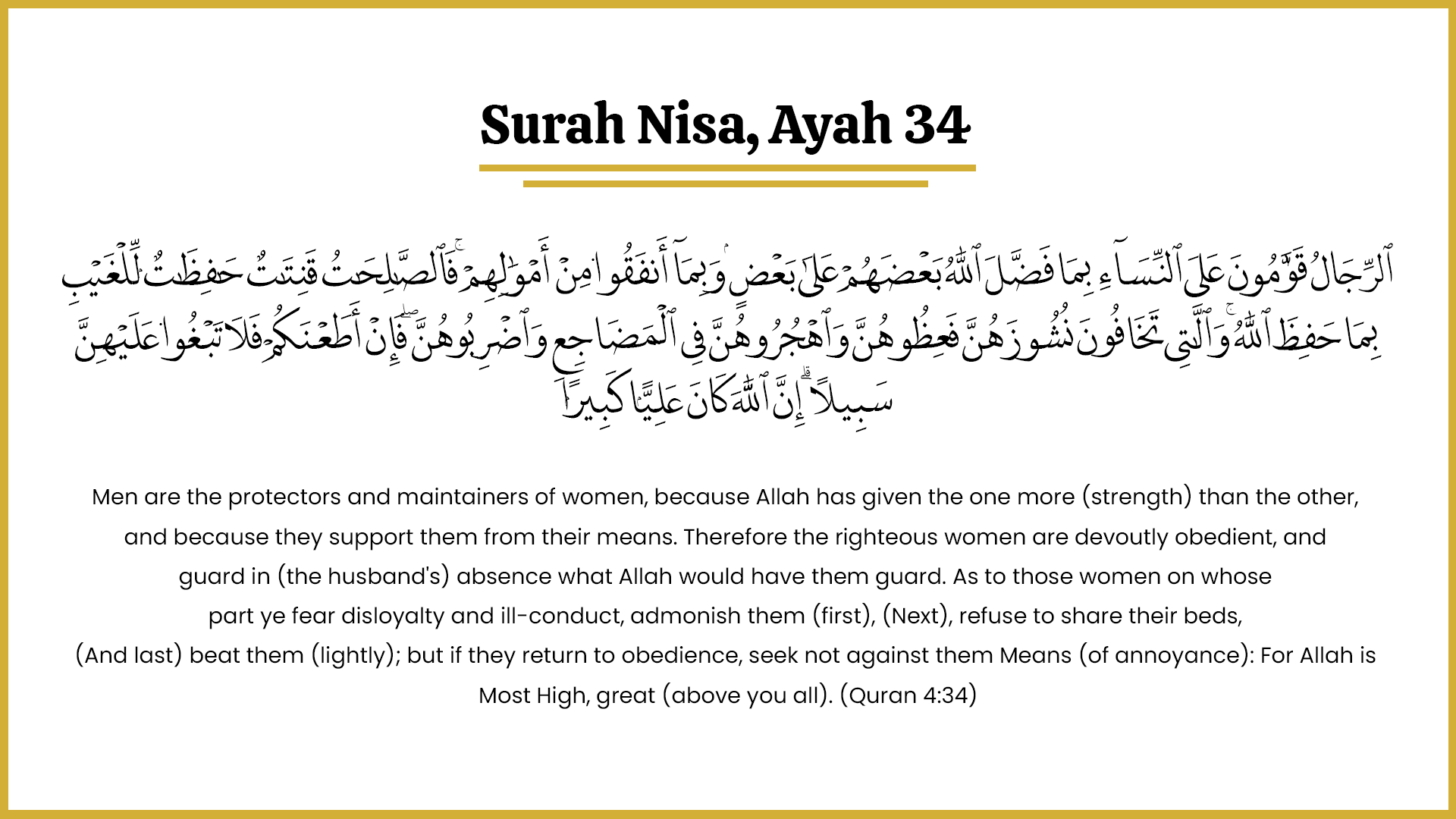
Men are the protectors and maintainers of women, because Allah has given the one more (strength) than the other, and because they support them from their means. Therefore the righteous women are devoutly obedient, and guard in (the husband's) absence what Allah would have them guard. As to those women on whose part ye fear disloyalty and ill-conduct, admonish them (first), (Next), refuse to share their beds, (And last) beat them (lightly); but if they return to obedience, seek not against them Means (of annoyance): For Allah is Most High, great (above you all).

Allah also commands the men in the same chapter:

O you who believe! You are forbidden to inherit women against their will; and you should not treat them with harshness, that you may take away part of the Mahr you have given them, unless they commit open illegal sexual intercourse; and live with them honourably. If you dislike them, it may be that you dislike a thing and Allâh brings through it a great deal of good.

Conclusion

I want to conclude by saying the purpose of this explanation is not to be apologetic. As muslims we do not apply our own meaning to the Quran and Sunnah, but the issue comes to be when people read these ayat and “jump” without seeking the proper knowledge on what is means and how it should be applied. Many muslims and non-muslims think its sufficient to interpret the Quran, while they lack in the Arabic language or while they don’t even know Arabic. This does not mean we cannot read the Quran, but if we don’t understand something, we must go to the people of knowledge that are able to explain with evidences.

The Article published in house of islam.com

Related Posts

Spiritual Diagnosis and Treatment of Occult Issues (1)

  The article discuss contemporary practices related to spiritual diagnosis and treatment of occult issues such as magic (jadoo), possession (jinn), and black magic in an Islamic context. emphasizes the prevalence of fraudulent claims by many self-proclaimed spiritual healers who exploit people’s fears under the guise of Islamic spirituality and Quranic teachings. The main goal is to educate the audience on how to recognize genuine spiritual practitioners, understand the correct methods of diagnosis and treatment, and avoid falling victim to deceitful operators. Key Insights and Core Concepts Widespread Misconceptions and Exploitation: Many people wrongly believe that their problems are caused by magic, possession, or evil eye, leading them to seek help from dubious spiritual healers who often manipulate Islamic terminology for monetary gain. True Spiritual Personality vs. False Claimants: A true spiritual person (Allah’s servant) does not advertise or make grand claims. Genuine spiritual figures focus on personal purification (tazkiyah), strengthening the heart, and guiding towards righteousness. False claimants often profess miraculous cures for all ailments, demand high fees, or insist on complex rituals and sacrifices, which is contradictory to authentic Islamic teachings. Misuse of Diagnosis Methods: Diagnosis of magic or possession is often done through dubious methods such as: Ilm al-Adad (Science of Numbers) Ilm al-Saadah/ (Science of Auspiciousness) Ilm al-Raml (Divination by Sand/Grains) Ilm al-Jafr (Esoteric Numerology/Scripture) These methods are commercialized, mechanized, or even computerized, which the speaker criticizes severely as incompatible with true spirituality. Criticism of Software-Based Spiritual Diagnosis: The speaker shares personal experiments with computerized diagnosis tools (e.g., Microsoft Excel spreadsheets) used to detect magic or possession, showing their illogical outcomes and emphasizing that such mechanized methods cannot replace sincere religious knowledge and practice. False Claims About Magic Types: The speaker rejects labels like “black magic,” “yellow magic,” “pink magic,” or “violet magic,” stating there is only one reality of magic linked to Shaitan (Satan), and treatment must come from Allah’s words, names, and blessings, never through magic itself. Financial Exploitation: Demanding fixed fees, specific sacrifices (like certain types of goats), or expensive items for spiritual treatment indicates a fraudulent practitioner. Role of Jinn and Spirits: The speaker explains that controlling jinn or claiming to receive help from them is both unethical and un-Islamic. Genuine spiritual personalities avoid such practices and discourage the imprisonment or coercion of jinn. Importance of Proper Quranic Recitation: A major obstacle to effective spiritual healing is incorrect or improper recitation of

Read More

Syed Sarfaraz A. Shah

Positive Thinking Positive Thinking: The First Step to Inner Sight https://www.youtube.com/watch?v=2nFfNvgsc1Y Facing Hard Times?  Syed Sarfraz Ahmad Shah sahb discuss adab of the dua by Hazrat Hasan Basri (RA) https://www.youtube.com/watch?v=W8HtD2rpjek Manners of Divorce Manners of Giving Divorce in Islam explain by Syed Sarfaraz  Shah. https://www.youtube.com/watch?v=xdKRey0zA_0 Tasuf ka Dosra Qadam Kahay Faqeer : Session 03 Tasawuf Ka Dosra Qadam https://www.youtube.com/watch?v=czoJk64iKws Mah e Rajab Kah eFaqeer: Mah e rajab Ki Ahmiyat o fazeelat https://www.youtube.com/watch?v=qOQlxeYBBb4 Arz e Faqeer Arz e faqeer : Session 1 Mushahiday Ke Liye Ilm Aur Jazb Ki Ahmiyat Syed Sarfaraz A. Shah Syed Sarfaraz A. Shah is highly educated professional. Having worked in numerous private and governmental institutions, Syed Sarfaraz A. Shah is a professional of vast knowledge and holds a wealth of information in Management and Administration. A scholar of Islam, Syed Sarfaraz urges Muslims to contemplate on the Message of the Quran. He advocates for Islam as a way of life and a system akin to democracy, autocracy, or socialism. According to him, all power lies within the “The law of God” inscribed in the Quran, which commands food and wealth to be shared equitably by all. He preaches that Islam is not a typical religion that is full of rituals, but rather an organized challenge to the concept of religion. Syed Sarfaraz A. Shah furthers his understanding by lecturing on and answering questions regarding the true meanings of Islam and Shariah, as well as one’s purpose, existence, and ultimate destination, or Manzil.

Read More

Professor Nadeem Khokhar

Responsibilities of Father A byan on a Father’s responsibilities of in accordance to Quran & Sunah. https://youtu.be/eb0wo7JHhpA 12th Rabiulawal The 12th of Rabi’ al-Awwal marks the auspicious day of the birth of Prophet Muhammad (PBUH)… https://www.youtube.com/watch?v=_dJdFXBJHL4 Understanding Jealousy Nature of Hasad (jealousy) in Islam and its negative impact on personal and spiritual well-being. https://www.youtube.com/watch?v=99M53jS8w4o Lecture 01 (Hadeeth Sciences) Lectures series of Hadeeth Sciences- 2024- Conducted by Professar Nadeem Khokar. https://www.youtube.com/watch?v=TpD146qW85Y&list=PLMIZyplGe5FRCqw6UxZUbBiMr18iXvufx Quranic Arabic (No Grammar) 001 Introduction of the course to Learn Arbic Language without Grammar. https://www.youtube.com/watch?v=ym8Rnbw404A Quranic Arabic (No Grammar) 003 Introduction of the course to Learn Arbic Language without Grammar Professor Mohammad Nadeem Khokhar Professor M. Nadeem Khokhar is a well-known Islamic scholar and teacher in the academic and spiritual fabric of Pakistan. He has made significant contributions through Faizan ul Quran Institute, which has emerged as a prominent hub for Islamic education in the country. Mr. Khokhar has educated himself from the Western International University, USA (UK Campus) and blended all that knowledge through modern technology with his deep commitment to Islamic studies. This ability to combine the scholarly with the spiritual has branded him as one of the most impactful educators in that he has offered transforming lives on many students. His endeavors still nurture intellectual and spiritual growth in his community.

Read More